Sunday, January 3, 2010

Monday, December 28, 2009
Thursday, December 17, 2009
Friday, August 28, 2009
Engineering is tough at Berkeley
But, if it means changing the world, lets bring it on!
Wednesday, August 19, 2009
History of Art 24: Looking at Berkeley Buildings!
 YES! I'm number 9 out of 10 on the waitlist and can still get into a class of 20 people! I'm really excited for the class I really want to join!
Thursday, July 23, 2009
Summer Thoughts and my philosophy in life. . .
Lately, I've been delving through, trying to discover what my philosophy in life should be. I might as well sort of be honest about myself here, as Midori was in Norwegian Wood (by Haruki Murakami) when she was vivaciously open about her love for sex. I'm not sure how far I'll ramble here, but at least my thoughts are out.
This summer has been a really wild and quiet summer of some sorts. Wild, because I've been meeting lots of new people, and trying lots of new things beyond my comfort zone that I hadn't done before in high school. Quiet, because I spend lots of the days in the house reading, drawing, thinking about how college (or wanting college to come closer!!) should be, listening to music, reviewing Calculus (!!) before Math 1b starts.
Part of me wants to change the world, but part of me realizes that I would be sacrificing part of my life to do so. I have to discover where that balance lies; so far, it's in terms of changing the world through changing the community while having fun with it. I want that wild side of life to remain!
Simultaneously, I can't wait for college. This is so embarrassing: I find myself humming "Hail to California!" everyday, because I want to just release my thoughts and interests out to the bigger world which will come out at Cal.
But, I can't release them right now. Since I'm at home a lot, I don't really get a chance to release my thoughts out. Sure, I can release them to my parents and my brother, but I'm the only one who's really passionate about my thoughts. I want to talk politics, Asian-American activism, history, Asian architecture, stories of the TWLF in the 1960s-1970s, architectural engineering, my philosophy in life.. etc.
This is where I feel alone sometimes in the midst of my quiet days. Even while I'm in the middle of reading, drawing, or reviewing Calculus, or whatever I'm doing, all these thoughts I just mentioned are all stuck in my mind. I'm actively thinking about them 24/7, even when I'm trying to sleep. I should mention that it takes me a whole hour after I fall in bed to go to deep sleep because I'm always thinking; this cycle has been going on all throughout my four years in high school.
Sure, you may be saying: why are you always thinking and having no action about action? I do want action; action takes teamwork, and you have to find a group of people to be willing to listen to your ideas. I haven't found that yet. If I don't have the opportunity to express those ideas out, what's the point of action?
Throughout my high school life, these ideas are what I always wanted to convey. However, the people I communicated with and environment around me did not facilitate the political thoughts that were always dancing in my mind, simply because they weren't interested. I had to be open minded to their ideas (and I did accept them). Now, it's my turn to release it out, because it hurts to keep them inside.
I'm not sure where I'm going with this, but I do get positive emails/comments about my YouTube channel from fans of Asian culture or Asian architecture. I know I've been on a hiatus on my video series; it's so difficult to do everything by myself that I had to stop, because I had been really tired and needed some sleep (and more outside help!). Those emails and comments are really encouraging because they show me that there is an audience outside that is interested in preserving Asian Architecture and the wonderful culture of Asia itself. I barely had sort of that kind of audience in my high school and in my friends I'm around.
Without those emails/comments, I probably would not continue, and just give up on my dream; preserving Asian architecture is like my biggest dream in me right now, because I want to know about my culture. I want to tell future generations of Asian-Americans, that your roots are important, and you should not let the media-generated stereotype of an "Asian nerd engineer, or martial artist" (being an engineer rocks, btw. But, don't let that technical side limit you!) limit your horizons on what direction one should go in painting Asian/Asian-American culture in the American fabric.
I always had a few comments at my high school (just a few! I get more comments from outside my school, ironically) saying my videos are educational, interesting, and informative, but no willingness or question from others in my school saying: "May I help?" Yes, you may be interested in my videos, but there's a difference between being interested and being passionate. Passionate involves deep action. I wish I can find, meet, and inspire people to be passionate about what lurks in my mind as I am.
In conclusion, part of me has discovered my philosophy in life: to change the world while having fun through preserving the cultural architecture Asia has to offer. Part of me wants to meet people who are as passionate as I am about this so I can release my thoughts so painfully stuck in my heart.
I think I'm inspired to re-continue an Asian architecture video I haven't finished for over a month. For those who are interested (or should I say, passionate), will you join me in the most radical dream ever?
Thursday, July 9, 2009
Political activism as defined by Haruki Murakami; You can't just talk the talk otherwise you'll become elitist, hypocritical, and uncaring.
Before I begin, let me sort of describe how I am "politically active" (not as a bragging tool). I wrote for the school newspaper and was really persistent in bringing the current events that were taking place in our school district, and had debates within our debate club related to political events. I spent a lot of my time (sometimes late night) reading late night news articles trying to understand what was going on around the world while forming a political opinion on what needs to be done around the world.
But, Murakami really challenged my political activism; this is how I interpreted it: you can't just talk the talk otherwise you'll become elitist, hypocritical, and uncaring. Yes, it looks really damn fancy and cool that you are above everybody else if you know something about politics, but what's the point of "political activism" if you can't comprehend this quote: "Nobody cares how much you know, but how much you care."?
Given that Murakami's tale takes place in the crazy 60s during the Japanese student protests, he places a very sexually liberated college student, Midori, in a student organization promoting "revolution" while ironically isolating her due to her ignorance and "slow understanding" (as definied by the group) of politics.
Midori joins a political group which uses big words she barely comprehends; the group does not make any attempts in explaining what those words mean. The first time she joins, she is told to read Marx, but since she can't understand it, nobody wants to associate themselves with her; meanwhile, the group goes on and lectures about political revolution. She notes that these people in the group, "aka" the working class, are trying to actually go up in social status just by impressing others with their political knowledge so they eventually be accepted (and quote, work for companies like "Mitsubushi and Fuji Bank").
These actions aren't political activism; that is plain arrogance and no action; how are people supposed to accept political activism (or politics in general) if this sort of elitist attitude exists, that people below your political knowledge aren't capable of being politically active?
This hypocrisy is apparent by the student protesters lack of full-sided commitment to the protests in the 60s. Toru Watanabe, the narrator, notes that in one semester, students went out of class just to protest the education system in Japan, and in another semesters, the protesters of the student movement aren't seen outside the classrooms as the leaders are all inside classes fearing that they won't graduate due to their involvement in protests.
That is true hypocrisy, letting fear or society's restraints (or society in general) lead one's lives in order to avoid changing the world.
But, how many of us who consider themselves "politically active" actually have been in these positions? Are you willing to go beyond the speech and debate part of politics that you see in high school, or the political junkies that claim they love politics to do something about the problems in the world? Are you afraid of changing the world (side note: how do you define changing the world; is it changing your community, changing your city, etc.?) because people claim you are too idealistic, don't realize the realities of government, and/or you fear you are hurting yourself?
After reading Norwegian Wood, I realized that I've been in this position and should not consider myself politically active, despite my knowledge about what's going on in politics.
It doesn't mean that much if I post Facebook links regarding political events going around the world, educating myself about issues in the Asian American community, or watching "political documentaries" or participating in all these ECs which enlighten your political thinking if the only thing you get out of it is a sense of pride for knowing a lot. It just doesn't, and that's what I have been doing these past few years.
How can I be politically active while going beyond being aware of the world around me?
Wednesday, July 1, 2009
How un-robotic can I become?
I have no regrets (as of now) being a civil engineering major, given my love for architecture and wondering: how is this building or bridge built?
However, many challenges in life make it really difficult for me to study civil engineering.
For example, two years ago, I wanted to major in Asian Studies because I loved (and still do) Asian culture. I have a strong passion for doing something to contribute to the Asian-American activist movement and contemporary Asian-American culture. Given my involvement in my school's debate club, I'm also into politics and other social sciences (especially sociology!). I'm pretty much somebody who has a open-minded love of the liberal arts that cannot be restrained.
UC Berkeley's College of Engineering, unlike the College of L&S, does not have specific breadth requirements for the Humanities/Social Science requirements. For example, in L&S, there are 6th breadth requirements (i.e. you have to take 1 philosophy course, 1 international/area studies course, one biological course, one social behavior course, etc.), whereas in College of Engineering, there are six humantites courses - two of them have to be English courses, and the four others can be anything you want (well, one have to be related to American Culture and the other has to be American History, but that's just a university-wide requirement). While I can use the CoE requirements and take classes specific to the L&S requirements, I get a bad impression of how the CoE treats the liberal arts. College is where one can be an open minded and well-rounded individual, but the CoE's leninency on the Humanitities/Soc. Science requirements show that well-rounded-ness isn't a priority.
These challenges make me feel robotic because I want to learn more about myself, as an individual. Engineers have an impact on everything in society, positively or negatively, and the humantities explains why people do what they do, especially, but not limited to, engineers.
I chose civil engineering because I wanted to preserve Asian Architecture (as well as promote sustainable design and improve our aging infrastructure). This is the field which allows me to do something about a number problems in our world today, while trying to understand my culture, which I barely understand.
My only hope is that people respect the field of engineering (and, for some, maybe enter it?), while putting out the need for engineers to be well-rounded in other fields. Engineering is very technical-based, specific, stereotypically (and sometimes truthlly) unsocial, and especially difficult; these characteristics make it difficult for people to even accept engineering, espeically when America needs them a lot.
I have a difficult time explaining and defending why I chose civil engineering, given that I sound more like a liberal arts major than an engineering major; I appreciate my open-minded-ness, and my belief is that people will appreciate this rare quality. Engineers can be social scientists too, historians, public policy influences, artists, performers, polticians, teachers, etc! I want people to accept me if I am a citizen-journalist in my free time, an Asian-American activist trying to promote Hmong cultural arts, a sociologist analyzing 3rd generation Asian-American families, or whatever it may be, all while being an engineering major.
While college majors are really specific, I choose to go to college because I want to learn about life in general, not primarily because I want to study a career-specific field just to get a career specific job.
Saturday, May 30, 2009
What I did today;
Since I haven't blogged much recently, a recap on my day (there are going to be a lot of blog posts tonight!):
- This morning, did the interview for UC Berkeley Alumni Association Leadership Scholarship; I thought I did okay, but man, the interview was challenging!
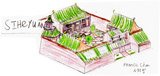
- Finished up a picture of a siheyuan (see here), although my drawing doesn't LOOK like represent the traditional "four housing" system the SIheyuan asks for (四合院, with 四 meaning four).
- 90% finished up with Part 1 of T'ang Chang'an. Realized I'm not forty-percent finished as I previously mentioned in a preview to my next Anshina's Architecture video.
- Created a networking-list of civil engineering / architecture majors & people for future use in my email account.
- Started adding people to my Arroyo Class of 2013 email list on my email account; won't be finished for a long time, since I'll have a big list.
- Looked up minors in UC Berkeley's College of Environmental Design; Minoring in Architecture, Sustainable Design, OR History of Built Environment seem to stand out the most.
Yikes, I don't think I can do the end of the year video for Class of 2009 like I thought I might~!
Friday, May 15, 2009
日本語を話しますか?
It's been a long time, since I was able to type like this!
I self-taught myself about two weeks (which I learned last summer) worth of Japanese in about two days! Crazy, right?!?!
皆さん、私はアメリカ人です。今は音楽を聞きます。
Sunday, May 10, 2009
Stress is mostly gone; now what?
For sure things:
- Anshina's Architecture - Tang Chang'an (almost 40% finished)
- Utopia Project for Philosophy.
- Begin planning self-taught Japanese lessons.
- Prepare an architecture portfolio.
- End-of-the year Brickfilm celebrating end of school year; dedicated to the class of 2009?
Saturday, April 25, 2009
Arroyo needs a real world curriculum, not a robotic curriculum

I'm going to try to keep this short (no guarantee, hah!), since I do write a lot of long things (although I've been told that there are more people outside my school who actually read my blog, which is quite interesting, from somebody from Los Angeles to another person up at UC Berkeley who reads this blog "a couple times"). This will be somewhat related to my school, Arroyo High School, but it has much to do with public education. You have the right to disagree with my statements; I was very hesitant about writing this and could not sleep because of this issue, so I have to put this down.
To students, staff, faculty, and administration of Arroyo High School and the San Lorenzo Unified School District:
I began to cringe after listening to the more technical details to last Friday's (4/24/2009) academic rally that took place in our gym. A few include: if students do not score proficient in English in the CST tests, they will be forced to take an extra block of English, and for the lower-performing students, all four blocks of English. Students will be forced to take yearlong of Algebra I next year at Arroyo. Students will be given prizes (i.e. a iPod nano, a waiver on an English assignment for the next school year) for performing well on the test.
Maybe, I don't have the exact details of these proposals stated clearly/accurately, but you get the idea. Sure, it's great to give a prize after doing so well in a test, but I question if giving a prize would be morally correct and right. And also, I question whether the consequences the lower-performing students face will actually help them. All these methods, as you all know, are designed to make sure we do well on the CST tests (we must be all proficicent in math and English by 2012, by the way), or we face losing funding and a takeover by the State of California.
My biggest question is: what has happened to the value of an education, to the point that we resort this far to get students to learn?
An Arroyo education must be geared toward the real-world, but I believe the methods Principal Larry Smith outlined doesn't encourage that for those who need it most: the lower-performing students.
In this case of giving four blocks of English toward a very, very low-performing student, I ask: What are you going to teach in those blocks? Sure, grammar, interpreting the text of a book correctly, or learning how to write an interpretive essay are important skills in the real world in order for our generation to be able to communicate orally or write articulately (I have to do this all the time with my Asian Architecture videos, and eventually, through engineering projects summing up our findings and solutions to problems), but what about other skills? What about the ability to be politicially active, to be able to summarize a lengthy news article or a long Newsweek magazine article (or extricate little details from the article? See this dense article as an example and tell me if you can grab the little details out of this baby: <http://www.newsweek.com/id/192583>), or to take a stand on a political issue and explain clearly why you stand for it (i.e. why did you vote for Obama?)? I call this applied English. Why? One of the biggest reasons why Obama won the election was through the Internet, and people were blogging heavily and discussing what Obama would do, especially young people (that's us!). Not all of us will be English teachers, English professors, or people within the social science fields, but all of us need to be prepared to handle these situations, especially in a time of increasing technology. If you can influence public policy very articulately, you are able to elect politicians that may be able to help you meet your needs.
I'll admit there are other real-world skills that I have not mentioned, because my spectrum on real-world decision making is based on how citizens of America can make an impact on public policy in government. But, let's move on to the math, which is much more appliable.
As for making Algebra I year-long, I question whether the classes will just only be about numbers, like how to do the quadratic equation, or whether you will emphasize over things such as how to do compound interest. The SF Chronicle notes <http://www.sfgate.com/cgi-bin/article.cgi?f=/c/a/2008/08/25/MNJU126FNT.DTL> that California's Algebra I ciriculum is just like that - very numerical and rule-like, but not real-world appliable. Did you know the iPod uses algebra to play music to shuffle your songs? Did you know your cell phone uses algebra to take in signals from other phones? That stop-light in the interesection uses algebra to change colors from green to red! Sure, it's complicated to explain how (it makes sense to me superficially, not technically), but you get the idea. If you want to give students a reason to do well in mathematics, what we learn in class needs to reflect applied math.
Now that I established the conclusion that the value of an education at Arroyo must be appliable to the real world (and gave a bit of solutions, suggestions. I'm not an education expert myself), I would like to introduce students to the San Lorenzo Unified School District's Director of Secondary Education, Melanie Spears. (http://www.sanlorenzousd.k12.ca.us/en/secondary.htm). She is in charge of "design, development, coordination and evaluation of curriculum and instruction in secondary grades". In other words, she helps organize and implement what you learn in high school.
Melanie Spears was an important figure of the block schedule crusade (http://www.youtube.com/view_play_list?p=C5EEC07253D9EE3B) as many believed she wanted to really change the block schedule to the period schedule.

However, that's not my focus; my focus is what Melanie Spears should do to implement an appliable, real-world curriculum for the low-performing students in the CST tests. In the first video of the YouTube playlist, you see school district superintendent Dr. Byas stating that Melanie Spears was "gathering information". Spears had a lot of time "gathering information" (i.e. MONTHS!!!!) from teachers about possibly changing the schedule to improve test scores. However, wouldn't that time be better spent on gathering information on what kids want to really learn (i.e. interview students on what real-world skills they want to gain out of English/Math?)? Ms. Spears definitely had the time to do that if she was able to spend months on researching a possible schedule change. Because of her educational expertise, I do believe she can implement a real-world curriculum (she did go to Cal, after all, a school which demands a real-world impact to society from all its students).
Ms. Spears and the rest of the school district: please consider that you aren't going to make an impact to our education system if all you are worried about is trying to be proficient in math and English. We aren't robots; we are human beings that need to contribute to this society, regardless of the extent of our impact in society. Therefore, instead of being surrounded by teachers, you need to make plans and a schedule to go out and ask what students really want to learn, even if it takes months. Be the transcendentialist person and go beyond test scores. Hey, DECA and the Health and Medicine Academy are great examples of campus organizations where students are definitely learning real-world skills, so why not do the same with low-performing students.
Therefore, my message for students is: evaluate what you really want to learn at Arroyo, and how that applies to the real world. Teachers who don't have that packed into their curriculum need to do the same to the curriculum. Let the adults know what you need for the real-world, and don't let tests limit you (I felt like a seven-year old listening to "test-taking tips" during the academic rally).
I shall briefly mention that I do believe that I was able to gain a lot of real world skills at Arroyo, but if you want to know personally how, please email me and I can give you my response.
If you feel that I am misrepresenting the views of the lower-performing students on the CST (and that's you), speak out! My definition of real-world skills may not fit yours, but this is your generation you will be representing. Tell us, tell Mr. Smith, and tell Ms. Spears what you need for the real world.
Sincerely,
Francis Chen
fncis.chen@gmail.com
http://www.youtube.com/user/metropolitianAnshin
http://metropolitananshin.blogspot.com/
Thursday, April 23, 2009

Friday, April 17, 2009

Thursday, April 16, 2009
Spring Break 09
I normally don't say much about life, but there's so much free time right now that I'm bored (well, except trying to get that 5 in AP Calc so I can likely take Multivariable Calc and Linear Algebra next year in college).
I can't wait to attend UC Berkeley now. The Chancellor's Reception thing was really intimidating though; I pieced together the caliber of people at Cal compared to at my school. At Cal, all the speakers who spoke gave me the impression that everybody has the inherent desire to make a impact, a HUGE one, in society. I wandered around and met random people, freshman applicants and students, and the expectations to be ambitious are huge (I met an aspiring poly sci major who wanted to make a difference in the Phillipines, which does not have a good government, and a current Asian-Am. studies major who really got a lot out of her courses). Nothing wrong with huge ambitions: my ambition and dream is to preserve Asian Architecture, and that's pretty daunting, especially since I know Cal has no Asian Architecture courses (the Asian-Am studies major suggested I should start a DeCal on it, lol). At my high school, that feeling of making a difference in society isn't as apparent, and is limited to like a few group of people.
As of now, I will be heading up to International Night and taking photos, and Cal Day this Saturday is bound to have great action shots.
Wednesday, April 1, 2009

Why 2am?
Thursday, March 26, 2009
Wednesday, March 18, 2009
UCLA!
You were selected from the largest pool of university candidates in the nation—more than 55,000 applicants. Your academic achievements and personal talents are exceptional, and your intellect and imagination will thrive at UCLA. We want you to join us in the Class of 2013."
YES!